Welcome to our detailed guide to optimum bottle care! This is a crucial step in ensuring your toddler's health and well-being. At Le Biberon Français, we understand the importance of providing your little ones with a safe and healthy environment. Regular bottle cleaning plays a vital role in this, preventing the growth of unwanted bacteria and ensuring optimal nutrition.

In this article, you'll find the key steps to effective cleaning, product recommendations and practical tips to simplify this daily task!

Cleaning your feeding bottle, step by step

You want to make sure you clean your baby's bottles properly! Here are the basic steps:

1. Rinse immediately after use

The first step is to rinse your bottle immediately after use with clean water. Each bottle should be thoroughly cleaned between uses.

2. Dismantle your feeding bottle

For complete cleaning, you need to dismantle the entire bottle. For Biberon Français feeding bottles, simply unscrew the ring, remove the teat and remove the red reduction ring for 360ml bottles. If you have used the cap, you will also need to clean it.

3. Clean every nook and cranny

The most important thing is to leave nothing to chance! Every part must be cleaned. If you have a Biberon Français feeding bottle, you're in luck because every part is easy to clean! Thanks to the bottle's wide neck, there are no hard-to-reach nooks and crannies. Alternatively, you can use suitable brushes to help you clean every corner of the product.

4. Insist on cleaning teats and caps

As you can imagine, the most important thing is to clean the teat, where baby sucks his milk. Please clean it thoroughly without leaving any milk residue.

5. Recommended cleaning products

It's important to choose products that contain no harmful substances to clean all your baby's products. You can easily find many special baby washing-up liquids on the market!

6. Optimum drying of feeding bottles

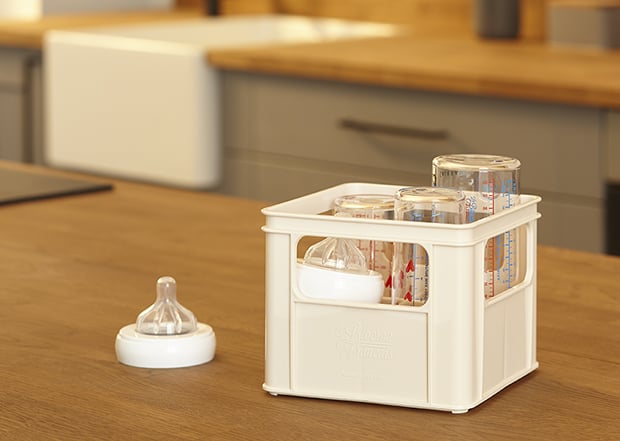
Once all the parts of the bottle have been thoroughly cleaned, it's time to dry your bottles using dedicated drying racks. Avoid using paper towels, for example, as they can leave residues. We recommend maximum ventilation to prevent bacterial proliferation.

At Le Biberon Français, you'll find a fully efficient vintage bottle drainer that can hold at least 4 bottles and their accessories. It doesn't have a bottom to prevent the build-up of stagnant water, so it sits on the dedicated area next to the sink. The little extra: it's so pretty that it can also be used for storage!

Can baby bottles be washed in the dishwasher?

You may already know this, but Le Biberon Français feeding bottles can be put in the microwave and dishwasher without any problems! It is generally safe and practical to put the different parts of the feeding bottle in the dishwasher with the rest of your daily washing-up.

The only part that shouldn't be put in the dishwasher is the teat. Being made of silicone, this part is often recommended to be washed by hand, as the high temperatures of the dishwasher could alter its texture or durability. On top of that, silicone is a material that picks up the colour and smell of food, so it could be stained by leftover sauces or food in the dishwasher, for example.

Should baby bottles be sterilised after cleaning?

The issue of sterilising baby bottles often gives rise to differing opinions. In fact, the INPES (National Institute for Prevention and Education), the French Neonatal Society and the French Ministry of Health all agree on one point: sterilisation is no longer considered a recommendation. To be truly effective, sterilisation requires extremely rigorous hygiene conditions and a very strict protocol, making it virtually impossible to carry out at home. In short, it's better to opt for meticulous, standard-compliant cleaning of baby bottles than to engage in approximate sterilisation.

Drying rack - sand color

(17 reviews)
€9.90
Product added to wishlist